Loading...
Future of AI
AI and Education Transformation: Learning in the Age of Intelligence
Quick test: what's the capital of Burkina Faso?
If you knew the answer, congratulations. That knowledge is now worth exactly zero. Because anyone can ask an AI and get the answer in 200 milliseconds.
Yet we still build entire education systems around memorizing and recalling information. We test students on their ability to store facts in their brains -- the one thing AI does infinitely better than humans.
Something is deeply broken.
The Current System Was Built for Factories
This isn't a hot take. It's history.
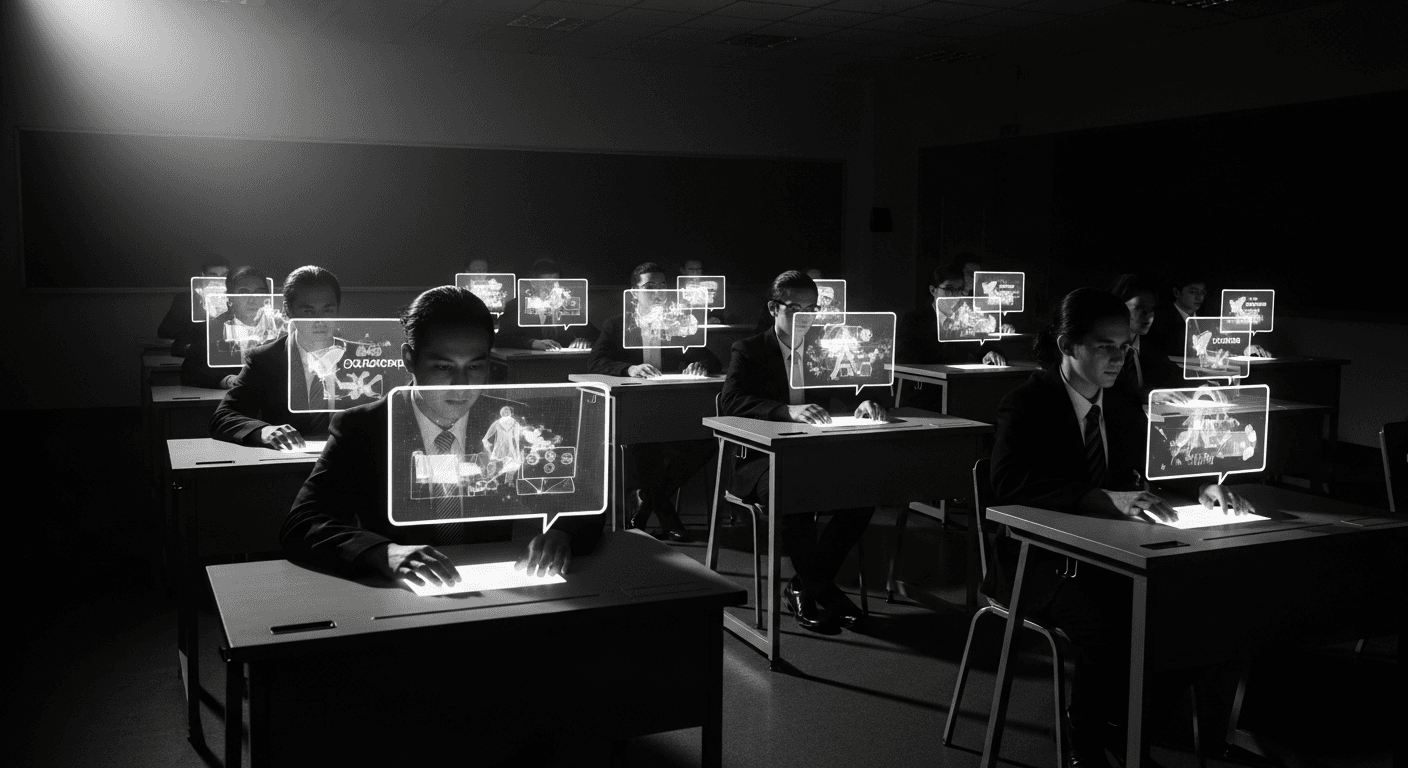
The modern education system was designed in the Industrial Revolution to produce factory workers. Sit in rows. Follow instructions. Memorize procedures. Perform standardized tasks. Don't question authority.
It worked for factories. It even worked, sort of, for the knowledge economy. You needed to memorize things because looking them up was slow. You needed standardized skills because jobs were standardized.
Neither of those things is true anymore.
Looking things up is instant. Jobs are changing faster than curricula can update. The standardized skills we teach -- basic coding, data analysis, writing reports -- are exactly the skills AI is automating.
We're spending 16 years (K-12 plus college) training people to be mediocre at things machines do perfectly.
What AI Changes About Learning
AI doesn't just change what we should learn. It changes how we learn.
Personalization at scale. The holy grail of education has always been personalized instruction. One tutor per student. Impossible at scale with humans. Trivially possible with AI.
An AI tutor adapts to your pace, your learning style, your knowledge gaps, your interests. It explains concepts three different ways if you don't understand the first. It never gets impatient. It never has a bad day. It remembers everything you've ever struggled with.
This isn't theoretical. Khan Academy's Khanmigo is doing it. Duolingo's AI is doing it. Dozens of startups are doing it. The results are significant: students learning 2-3x faster with AI tutoring versus traditional instruction.
Learning by doing, not by absorbing. Traditional education: read the chapter, attend the lecture, take the test. AI-augmented education: try the thing, get immediate feedback, iterate.
Want to learn coding? Don't read a textbook. Start building with an AI coding assistant. It corrects your mistakes in real-time, explains concepts when you need them, and lets you make progress immediately. The motivation loop is tighter.
Want to learn writing? Don't attend a lecture on essay structure. Write an essay. Have an AI analyze your structure, argument quality, and prose style. Revise. Repeat.
Mastery-based progression. Traditional education moves everyone at the same pace. Chapter 3 this week, whether you understood Chapter 2 or not. AI-augmented education waits until you've actually mastered a concept before moving on. No artificial pace. No moving on with knowledge gaps.
What We Should Actually Teach
If AI handles information retrieval, calculation, and basic analysis, what should humans learn?
Critical thinking. Not "think critically" in the vague way schools say it now. Specific skills: evaluating source reliability, identifying logical fallacies, understanding statistical reasoning, recognizing cognitive biases, distinguishing correlation from causation.
Why this matters: AI generates plausible-sounding content that's sometimes wrong. The ability to evaluate AI output -- to know when to trust it and when to question it -- is a survival skill.
Problem formulation. AI is great at solving well-defined problems. Humans need to be great at defining what the problem is in the first place. What question should we ask? What framework should we use? What constraints matter?
This is radically undervalued in education. We give students problems and ask them to solve them. We should give students situations and ask them to identify the problem.
Communication. Clear writing. Persuasive speaking. Active listening. Collaborative discussion. These skills become more important as AI handles more execution. The human role shifts toward coordination, persuasion, and meaning-making. All of which require communication.
Creative thinking. Not "art class" creativity. Cross-domain thinking. Connecting ideas from different fields. Seeing patterns others miss. Imagining things that don't exist yet. This is the human comparative advantage over AI, and we barely teach it.
AI literacy. Understanding what AI can and can't do. How to prompt effectively. How to evaluate AI output. How to integrate AI into workflows. When to use it and when not to.
This isn't a specialized skill anymore. It's as fundamental as reading and math. Every student should graduate with practical AI literacy.
Ethics and judgment. AI can optimize for any objective. But choosing the right objective is a human responsibility. Understanding ethical frameworks, wrestling with trade-offs, making judgment calls in ambiguous situations -- these are deeply human skills that become more important as AI handles more decisions.
What's Actually Working
Let me name some things I've seen that actually work.
Project-based learning with AI tools. Students tackle real problems using AI as a tool. Not "write an essay about climate change." Instead: "Design a solution for reducing energy waste in our school. Use AI for research and analysis. Present your proposal." The AI handles information gathering. The student handles problem-solving, creativity, and communication.
AI as debate partner. Students argue positions against an AI that pushes back with counterarguments. They have to defend their reasoning, acknowledge weaknesses, and refine their thinking. Better than arguing with other students who don't have enough knowledge to push back effectively.
Real-time tutoring. Students working through problems with an AI tutor that provides Socratic guidance. Not giving answers -- asking questions that lead to understanding. The best implementations feel like having a patient, brilliant mentor available 24/7.
Portfolio-based assessment. Instead of standardized tests, students build portfolios of work. Projects, analyses, creative works, reflections. AI helps evaluate at scale, but the work is genuine and demonstrates real capability.
The Resistance
Schools will resist this transformation. Here's why, stated honestly:
Teachers' jobs are threatened. Not all teachers. The best teachers -- the ones who inspire, mentor, and guide -- are irreplaceable. But teachers who primarily deliver information and grade papers are doing things AI does better. That's a hard thing to say. It's also true.
Testing companies lose power. Standardized testing is a multi-billion dollar industry. If we move to portfolio-based and mastery-based assessment, that industry shrinks dramatically. They'll lobby against change.
Parents want familiar schooling. "That's not how I learned" is a powerful objection. Parents who went through traditional education expect their kids to do the same. Even if traditional education is increasingly irrelevant.
Equity concerns are real. AI-augmented education requires devices and internet access. Not all students have these. Moving to AI-first education without solving the access gap widens inequality. This is a legitimate concern that requires investment, not just good intentions.
What Individuals Should Do Now
Don't wait for schools to catch up. They won't do it fast enough.
If you're a student: Use AI as a learning tool now. Don't use it to cheat on assignments -- use it to actually learn. Have it explain concepts. Debate with it. Use it to explore topics deeper than your curriculum goes.
If you're a parent: Teach your kids to use AI responsibly. Help them develop the skills that complement AI: critical thinking, creativity, communication. Don't worry about them memorizing math facts. Worry about them understanding mathematical thinking.
If you're a professional: Your education didn't end at graduation. It's just beginning. The skills you need are changing faster than ever. Learn AI literacy. Practice critical evaluation of AI output. Develop the human skills that AI can't replicate.
If you're a teacher: Experiment. Use AI in your classroom. Let students use AI on assignments -- but change the assignments so that AI assistance reveals understanding rather than shortcuts it. Be the mentor, not the information source.
The Opportunity
Here's the optimistic view:
AI makes the best education in the world available to everyone. A kid in a rural village with a smartphone can have a world-class tutor. That's never been possible before.
But only if we let it happen. Only if we redesign education around what humans need to learn, not what institutions are comfortable teaching.
The transformation is starting. It's messy. It's controversial. But it's necessary.
Because we can't keep training people for a world that no longer exists.
Related Articles
Industry Solutions
Industry Solutions9 min read
AI in Education: The Era of Personalized Learning
Educational institutions use AI to create personalized learning paths, automate assessment, provide tutoring support, and improve student outcomes.
Jan 15, 2026Read
Future of AI
Future of AI10 min read
AI and Employment: The Real Impact on Jobs and Careers
How AI is reshaping employment — which jobs are most affected, which new roles are emerging, and how to position your career for an AI-powered economy.
Jan 23, 2026Read
Future of AI
Future of AI8 min read
The AI Consciousness Debate: What It Means for Technology and Society
Is Claude conscious? Is GPT-4 sentient? Wrong questions. The right question: does it matter? And the answer is more complicated than you think.
Apr 3, 2026Read
Want to Implement This?
Stop reading about AI and start building with it. Book a free discovery call and see how AI agents can accelerate your business.